Friday, July 31, 2015

Social media to learn a new language

In addition to Duolingo, there are other social media to learn a new language. For example,

BusuuItalki
Lang-8
Live Mocha
My Happy Planet
Palabea
VoxSwap

All of them provide learners opportunity to find native speakers of the new language to help correct writing, chat, watch instructional videos, or answer questions. Among those social media, I especially like Live Mocha and Palabea.

Live Mocha provides learner incentives, Mocha and teacher points, for learning. For actively engaging in the site or completing course works, learners could earn Mocha points, and for helping other users with correcting, flashcards or translations, they could earn teacher points. With those points, users could enjoy more functions provided by the website.

In Palabea, learners could record their own video lesson and then upload to the site, which is also used in my class before knowing this website.

I think those two ides in Live Mocha and Palabea are also great for classroom learning. I have tried the later one for two semesters and receive great feedback from my students.

What do people think about using social media in education?

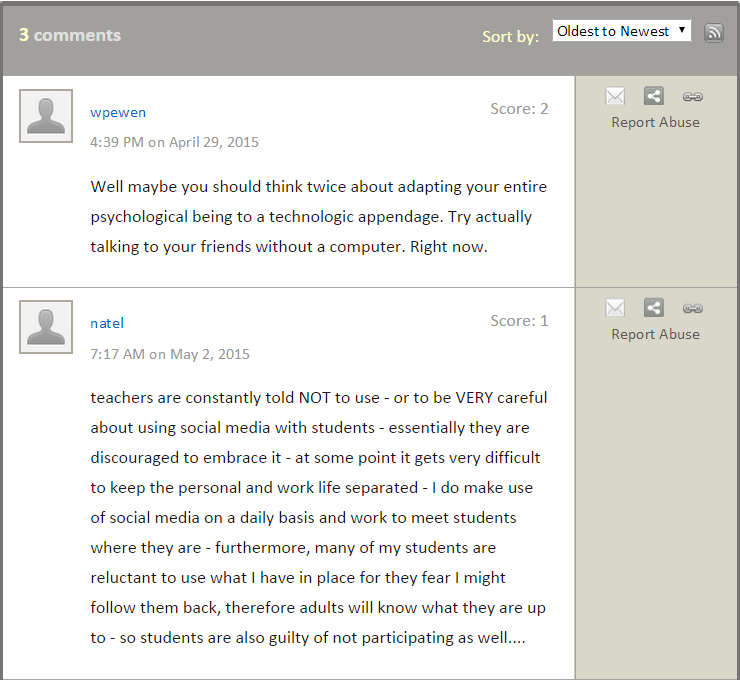
I cam across read an article, My Favorite Teachers Use Social Media: A Student Perspective, which believe that students will appreciate instructors' using social media in classroom and thus encourages instructors to do that. The article is quite common. But the following three comments are interesting.


All of the three comments indicate that people have negative opinions about the usage of social media in education. They think that (1) social media let people ignore real-life communication; (2) students dislike instructors using social media in education because of fears about instructors "stalking" them and performing not well; and (3) technology, including social media, fail to actually attract students' attention.

We are students majoring at instructional technology and thus are enthusiastic about social media in education. However, in most of other majors, social media seem to be seldom used by instructors. Moreover, many people hold similar opinions with the aforementioned three comments. These really give us challenges to design effective usage of social media in education and promote it.

Cultural differences on social media

Do you think there are culture differences on social media among different countries?

Yes. For example, Asian people are fans of male stars look like this:


and this:


I think most of American won't be obsessed by them.

Some people think that there are cultural differences in how people want to meet
why Facebook will not rule the world is among different countries. For instance, "In Australia and the US, most of us grew up with a sense of comfort in who we are, but we're lucky that way," says Steven Goh, co-founder of social network Migme. "In Indonesia, the Middle East, parts of Asia, it's not the same and they want to be able to play online without it having real world ramifications. So we let them create a virtual identity, which is very important for our users."

And thus we see the two new social media based on the belief: Migme and GetYou. Different from Facebook, Migme allows people to use names (rather than real names) or avatars they like and GetYou users are encouraged to meet new people rather than people they already know.

In China, most of people like to use screen names rather than real name, but at the same time they like to have official authentication by Sina Weibo. Most of social media in both China and America do allow users have options to choose to use real or screen names.

Also, in my opinion, GetYou will not be popular in China because most of people are on the alert of fraud.

Employers are "stalking" you without being noticed

I came across the article and found that employers could use many ways to "stalk" you without being notice by you.

For example, create a private list so that employers won't be listed as a follower, use
Facebook Graph Search to find hidden photos and posts, change the setting of LinkedIn or search LinkedIn profiles under the radar to be anonymously for "Who's Viewed Your Profile". 

In the article, the author illustrated "six red flags that may indicate trouble ahead":
  • Negative posts about a past employer.
  • The regular use of graphic or unprofessional language.
  • Excessive typos or poor grammar.
  • Frequent party/drinking photos.
  • Constant negativity or blaming.
  • Any posts or images that contradict facts or history from resume or interview
Meanwhile the author also mentioned that "it's important to look for behavioral patterns rather than one-off posts or images".

After knowing these, will you still keep active in posting? Will you still post your real thinking? When posting something, will you think about or avoid sensitive topics or words? Will you only show your positive side on social media?

As a lurking on social media, I seldom post anything on social media. Will employers think me as an introverted, withdrawn, and unsociable person so that I might lose some job opportunities?

Or we just keep what we are on social media and do not care about employers "stalking" us?

What do you think?

Saturday, July 25, 2015

Continue a Conversation on Social Media

I read an interesting article that provides 10 ways to continue a conversation with someone on social media. And I am thinking whether those ways could be also useful in conversation in classroom.

#1: Wish Your Followers A Wonderful Week/Weekend
Yes, wishing students a good day after class will help enhance relationships with students.

#2: Ask A Question
Yes, always asking questions to students to get feedback and stimulate their thoughts.

#3: Have Multiple Conversations With The Same Person
Yes, it would be good to have conversation with students in the class and after class.

#4: Thank Your Followers For Sharing Your Content
Yes, encouraging students to share their thoughts, achievements, and methods could fulfills their sense of accomplishment as well as facilitates communication among the class.

#5: Include Pictures In Your Posts
This could be understood as using multiple medium in instruction.

#6: Only Talk To The Right People
No, instructors should talk to all of students, not just students that show interest in lecture.

#7: Respond Quicker
Yes, this gives good impressions to students.

#8: Quiz Your Followers
Ooh, instructors always quiz their students.

#9: Poll
That would be good to get to know students.

#10: Thoughtfully Contribute To The Conversation
Of course, instructors should guide conversation and provide thoughtful contribution to the conversation.

Should Instructors Use Social Media to “Monitor” Students?

You all might hear this news: 

"18-year-old Robert Brever of Broken Arrow Oklahoma allegedly stabbed his parents and three siblings in a late-night attack. Authorities have charged him with five counts of first-degree murder and a count of aggravated assault."

Oklahoma police are searching Brever’s social media accounts, including Facebook and Pinterest, trying to find clues about his motives. This way to find more insight about criminal suspects is not new. Also, social media can provide police with warnings, because people nowadays are open to share their experience, interest, and thoughts in social media.

Drawn inspiration from police using social media, it seems like that instructors should use social media to get to know their students, their students' performance, opinions about the instructors and courses. For example, knowing students' interests could help instructors design and develop instruction material and strategies and thus motivate students.

On the contrary, there are still many challenges in implementing this in the real world. Doing this means that instructors should spend much more time after the class. Also, will students post their real thoughts when they know that their instructors are "monitoring" them. More importantly, students might not like to be known through their social media. Even if students friend with their instructors, they still could block instructors seeing some posts by changing setting in social media.

Thursday, July 23, 2015

Fansub


Fansub are subtitles for foreign movies and TV shows translated by fans rather than officially translation organizations.

Americans might be unfamiliar about it, but almost every Chinese people have watched foreign movies and TV shows with fansub. I will not talk about intellectual property here, although it is a controversial issue.

Fansub could be regarded as user-generated content and thus has many strengths.

1. It is easy to understand, because fans use easy and humorous words, phrases, and ways to translate foreign languages. Also, they often add comments, their understandings, and related knowledge into fansub.

2. It creates many buzzwords and interesting names for characters in movies and shows and actors.

3. It is a collaboration work with common property and individual credits shown at the beginning oe end of the movie or show.

4. Fans are naturally engaged in translating, because they are fans of the movie or show. Most of fansub translators are students studying overseas and it is very common for them to stay up late to translate without any compensation.

Whenever students could become fans of disciplines, maybe we do not need to think ways to activate them in learning.